
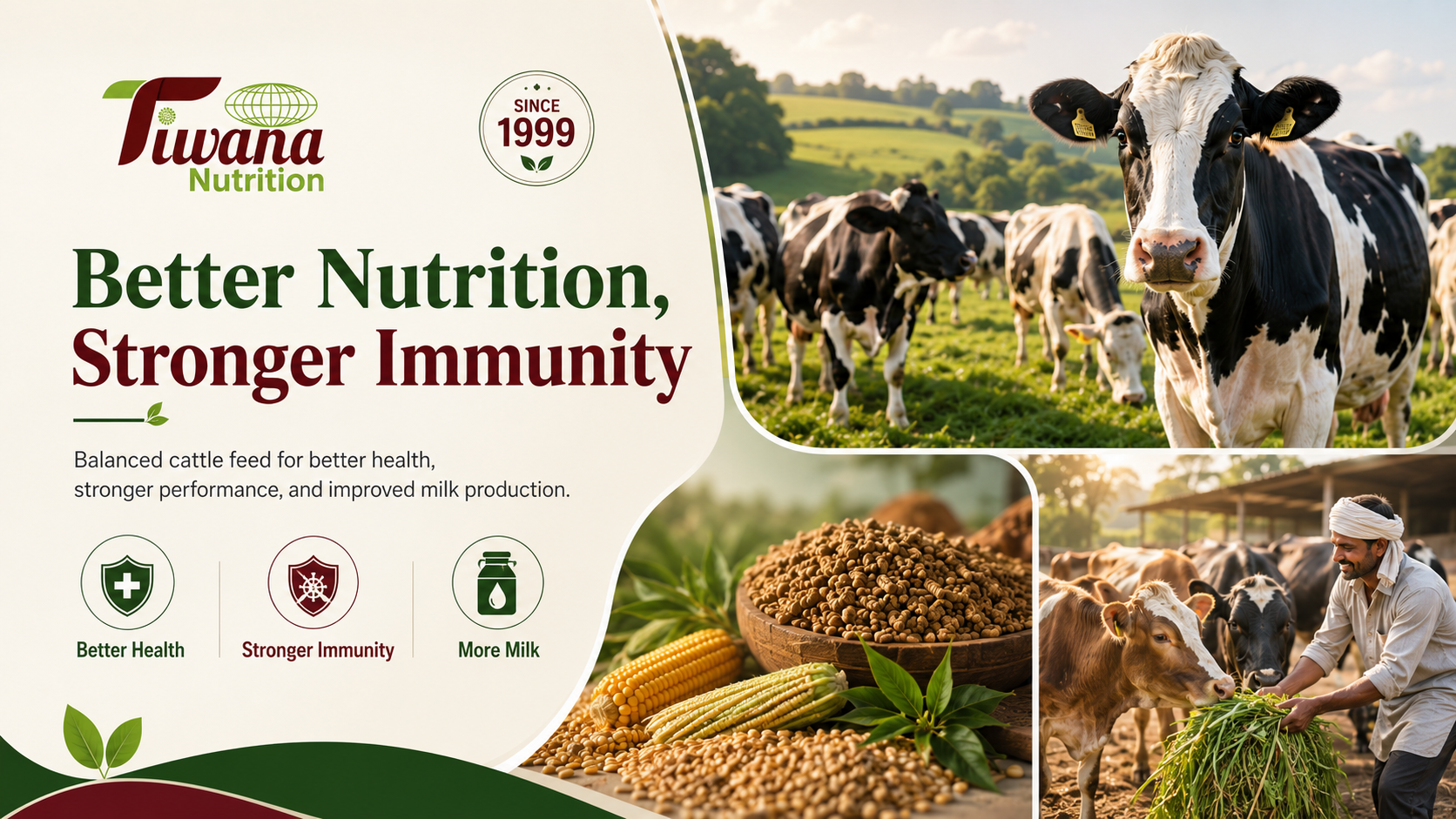
How Proper Nutrition Improves Cattle Health and Immunity
What an animal eats every day has a greater impact on its health and productivity than almost any other management practice on the farm. Healthy cattle are not the result of luck; they are the outcome of consistent, well-informed feeding decisions made over weeks and months.
A well-balanced diet provides the nutrients needed to maintain health, meet daily energy requirements, support growth and reproduction, sustain milk production, and preserve optimal body condition throughout changing seasons and production stages. In contrast, poor nutrition or irregular feeding practices may not show immediate effects, but their consequences gradually accumulate, leading to reduced performance, compromised immunity, reproductive problems, and increased susceptibility to disease.
Cattle feed,is far more than a routine task performed twice a day. It is one of the most important management tools available to farmers. Through proper nutrition, producers can meet the animal’s continuously changing biological requirements—requirements that vary with age, breed, body weight, physiological status, level of production, and environmental conditions. A carefully planned feeding program is therefore the foundation of profitable, sustainable, and healthy livestock production.
Why does nutrition matter this much?
Growth, activity, and condition all trace back to one thing- whether the animal is getting balanced nutrition consistently, not occasionally. Skip that consistency, and even straight forward farm tasks, like tracking weight gain or managing a calving schedule, start getting harder to manage than they should be.
Feeding done well supports:
- Steady body condition across changing seasons
- Reliable growth and maintenance over time
- Stronger output and productivity across the farm overall
Farmers who manage it well usually aren’t running complicated systems with constant adjustments- they’re simply feeding consistently and matching the feed to the animal in front of them, week after week.
| Nutrition component | Role in cattle health |
|---|---|
| Protein | Supports growth and body condition |
| Energy | Meets daily requirements |
| Minerals | Supports core body functions |
Each of these plays a distinct role, and the absence of even one tends to throw the whole balance off over time.
The effect isn’t always visible right away- it tends to show up gradually, in body condition or milk yield, well after the gap first appeared in the diet.
What’s the connection between feed and immunity?
Animals fed consistently tend to hold a more stable condition month over month, rather than swinging between good weeks and rough ones. The benefit here doesn’t come from any single feeding session done particularly well- it accumulates from a routine maintained steadily over time.
A dependable feeding pattern helps:
- Maintain steady body condition through the year
- Balance daily energy needs without big swings
- Close small nutritional gaps before they widen into real problems
Farmers who run structured feeding programs frequently report something else, too- their animals become noticeably easier to predict, both in behaviour and performance, which makes the rest of farm management smoother as a result.
Why can’t every animal eat the same thing?
A calf, a pregnant cow, and a lactating buffalo are biologically asking for very different things from their feed, even though they might be standing in the same shed, eating from the same trough setup. Applying one feeding plan across all of them ignores that reality, and tends to shortchange whichever group has the least flexible needs.
Calves need support geared specifically toward early growth, when their bodies are developing fastest. Lactating animals require considerably more energy to sustain milk output without losing condition.
Pregnant animals need a carefully balanced approach through the transition period leading up to calving, and heifers need steady, ongoing support as they continue developing toward maturity.
| Animal stage | Nutrition focus |
|---|---|
| Calves | Growth and development |
| Heifers | Body growth and preparation |
| Pregnant animals | Support during transition |
| Lactating animals | Production-focused nutrition |
Recognising these differences is really what separates a planned feeding routine from one built purely on habit- feeding the same way simply because that’s what’s always been done.
Which Tiwana products map to which stage?
Matching a formulation to an animal’s actual stage is the whole premise behind Tiwana’s product range, rather than offering one general-purpose feed and hoping it covers most cases reasonably well.
| Product | Suitable for | Purpose |
|---|---|---|
| Calf Starter Plus | Young calves | Supports early growth |
| Calf Grower | Growing calves | Supports development |
| 35 Protein | Heifers | Supports growth stage |
| Tiwana 8000 | Lactating animals | Designed for milk yield range |
| Milk+ | Milk-producing animals | Supports dairy nutrition |
Each product targets a fairly specific need rather than trying to serve every animal at once. The underlying logic stays simple- right feed, right stage- even though the formulations behind each product are anything but simple.
How does this filter into daily farm management?
Once feeding decisions are grounded in real dairy nutrition principles, the rest of the day tends to organise itself around that structure, rather than around whatever seems most urgent in the moment.
Planning feeding this way supports:
- A fixed, repeatable routine that doesn’t shift week to week
- Management tailored to each animal’s specific stage
- Closer alignment between feed and actual production output
- Easier tracking of how individual animals are doing over time
Farmers working this way tend to spend less time reacting to problems after they’ve already taken hold, and considerably more time staying ahead of them before they ever become
visible issues.
What should farmers weigh before choosing a feed?
Brand loyalty and convenience matter less here than most people assume when they’re standing in a feed store deciding what to buy. What actually determines the right choice is the specific animal standing in front of you, not what’s easiest to find or most heavily advertised.
Worth checking before any purchase:
- The animal’s age
- Its current stage- growth, pregnancy, or lactation
- Existing body condition, assessed honestly rather than optimistically
- The quantity actually recommended for that particular situation
Skipping these checks is usually how underfeeding or overfeeding happens in the first place, and both eventually show up in performance- sometimes within weeks, sometimes only after a full production cycle- even if neither looks like an obvious problem on day one.
How does Tiwana Nutrition support this kind of approach?
A structured feeding plan only works in practice if the options available to a farmer are actually clear and easy to match against real needs, rather than buried in technical specifications. That’s the principle Tiwana has built its product range around from the start.
The logic stays consistent throughout the range:
- Match feed to the animal’s stage, not just its species
- Maintain consistency in daily feeding rather than switching often
- Support broader dairy management goals, not just one feeding session
This frees farmers to spend more of their time on direct herd care- health checks, milking routines, calving support- rather than constantly second-guessing which feed to reach for next.
Building healthier cattle through better nutrition
Strong cattle health is the product of accumulated decisions, not a single intervention or one particularly good batch of feed. Feeding happens to be the decision farmers make most often, which is exactly why it carries so much weight over time.
Done properly, it leads to:
- More stable dairy management across the herd
- Animals holding better condition through every season
- Long-term gains in productivity that compound year over year
Reliable cattle feed, paired with sound dairy nutrition principles, gives a farm operation something solid to build on, season after season. Structured options like the ones we at Tiwana Nutrition offer give farmers a clearer, more dependable path to follow, rather than relying on instinct alone.
FAQs
1. How does cattle feed affect animal health?
It supplies the nutrients animals need for growth, maintenance, and daily energy, which keeps them in better overall condition over time.
2. Why does dairy nutrition matter for dairy animals?
It ensures animals receive a proper balance of nutrients for milk production and routine body maintenance, both of which depend on consistent feeding.
3. Which Tiwana products suit calves specifically?
Calf Starter Plus and Calf Grower, both designed around early and ongoing calf development.
4. Can one feed work across all cattle?
No- different stages carry different nutritional needs, so the right feed depends on the animal’s age and production stage at the time.
5. What should farmers check before selecting a feed?
Age, production stage, current body condition, and the recommended feeding quantity for that particular animal.